Illawarra Hawks History

Illawarra Hawks History
Illawarra Hawks History
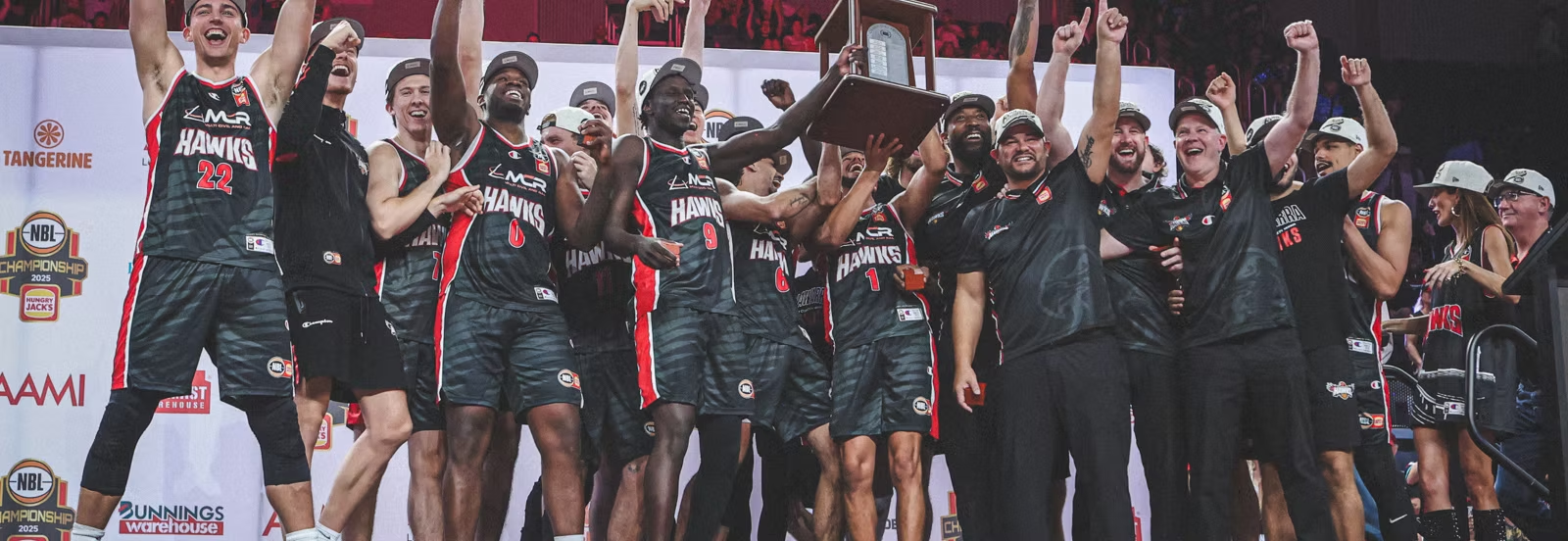
NBL Champions: 2000/01 and 2024/25
All Time Top 10 performances
From the Snakepit to the Summit: A Hawks History
Before the confetti rained down at the WIN Entertainment Centre in March 2025, there was a whole lot of Illawarra (Wollongong) Hawks history that had to happen first.
And most of it was hard.
The Hawks didn't arrive at their second NBL Championship through luck or circumstance. They got there through nearly five decades of grit, near-collapses, moments of sublime basketball, and a community that simply refused to let go. To understand what 2024/25 meant, you have to understand where this club has been.
It starts in 1974, before the NBL even existed, when a bloke named John TrivellionScott took over as coach of a local men's team and gave them a name: the Hawks. And with it, a motto that said everything about what this club would become -- "It's Hell Handlin' a Hawk." Five years later, when the National Basketball League launched its inaugural season in 1979, Illawarra was one of ten founding clubs. They finished 5-13, eighth out of ten. It wasn't pretty. But they were there.
That original commitment, turning up and competing from Day One, matters. The Illawarra Hawks are the only club to have played every single NBL season since the competition began. Every. One. That's not just a trivia answer. It's a statement of character.
The First Superstar, the First Heartbreaks
In 1981, the Hawks got their first genuine game-changer. Michael "Mike" Jones, an Alabama-born forward with a scoring touch that left defenders helpless, claimed the NBL MVP award, the first in club history. Averaging nearly 30 points per game, Jones turned the Snakepit into a place opposition teams genuinely didn't want to visit.

But sustained success proved elusive through those early years. Playoff appearances came and went. Financial pressures loomed. In late 1983, the club came dangerously close to folding entirely, saved only by a timely sponsorship from Ron Cross of Cross Country Motors. That lifeline, and Cross's insistence that he only wanted to be associated with winners, led to the appointment of American Dave Lindstrom as the first paid head coach in club history in 1986.
What followed was a genuine golden era of competitiveness. The Hawks went deep in the finals regularly. They developed local legends. They introduced the "Killer Bs" (Jim Bateman, Ray Borner, and Don Bickett) as a feared frontcourt unit. Crowds packed the Snakepit, a cramped, noisy venue that opponents described as unlike anywhere else they'd ever played. It was electric. It was theirs.
The Snakepit Years and What They Built
Through the late eighties and into the nineties, under Alan Black and then Brendan Joyce, the Hawks became genuine finals contenders. Melvin Thomas emerged as a two-way force, earning multiple All-NBL honours. Doug Overton brought future NBA pedigree to the roster. And in 1995, a young forward named Glen Saville walked through the door.
What Saville would go on to become for this club is almost impossible to overstate. Across a career that ultimately produced 527 games, 6,865 points, 4,041 rebounds, 1,847 assists, 776 steals, and 423 blocks in the red and white, all club records, Saville was the Illawarra Hawks. Quietly brilliant, unfailingly consistent, and utterly irreplaceable.
In 1998, the Hawks played their last season at the Snakepit. There's genuine nostalgia when people talk about that place. Fans who hurled a baby's dummy onto the court every time an opposition player threw a tantrum. Power outages during crucial games against Sydney, which the Snakepit faithful considered something between karma and organised chaos. The sheer noise of a building that was, frankly, too small and too loud and exactly right.
The final regular-season game was a 109-97 win over Townsville. The crowd was packed. The emotion was real. But it wasn't quite the last chapter. The Hawks still had an elimination final against Perth, a loss that nonetheless saw them exit with their heads high. Then they moved to the WIN Entertainment Centre. Bigger, shinier, and the stage for everything that came next.
The Championship: 2000/01

Brendan Joyce's Hawks had been building toward something. In 2000/01, it arrived.
The regular season was strong: 21 wins, a playoff berth. But it was the postseason that created mythology. In the semifinals against Adelaide, with the Hawks trailing in a deciding game and seconds left on the clock, guard Damon Lowery launched a desperate shot from beyond the arc, was fouled, and sent to the free-throw line. Three shots. The entire season, the whole thing, hanging on his wrist.
He rattled in all three.
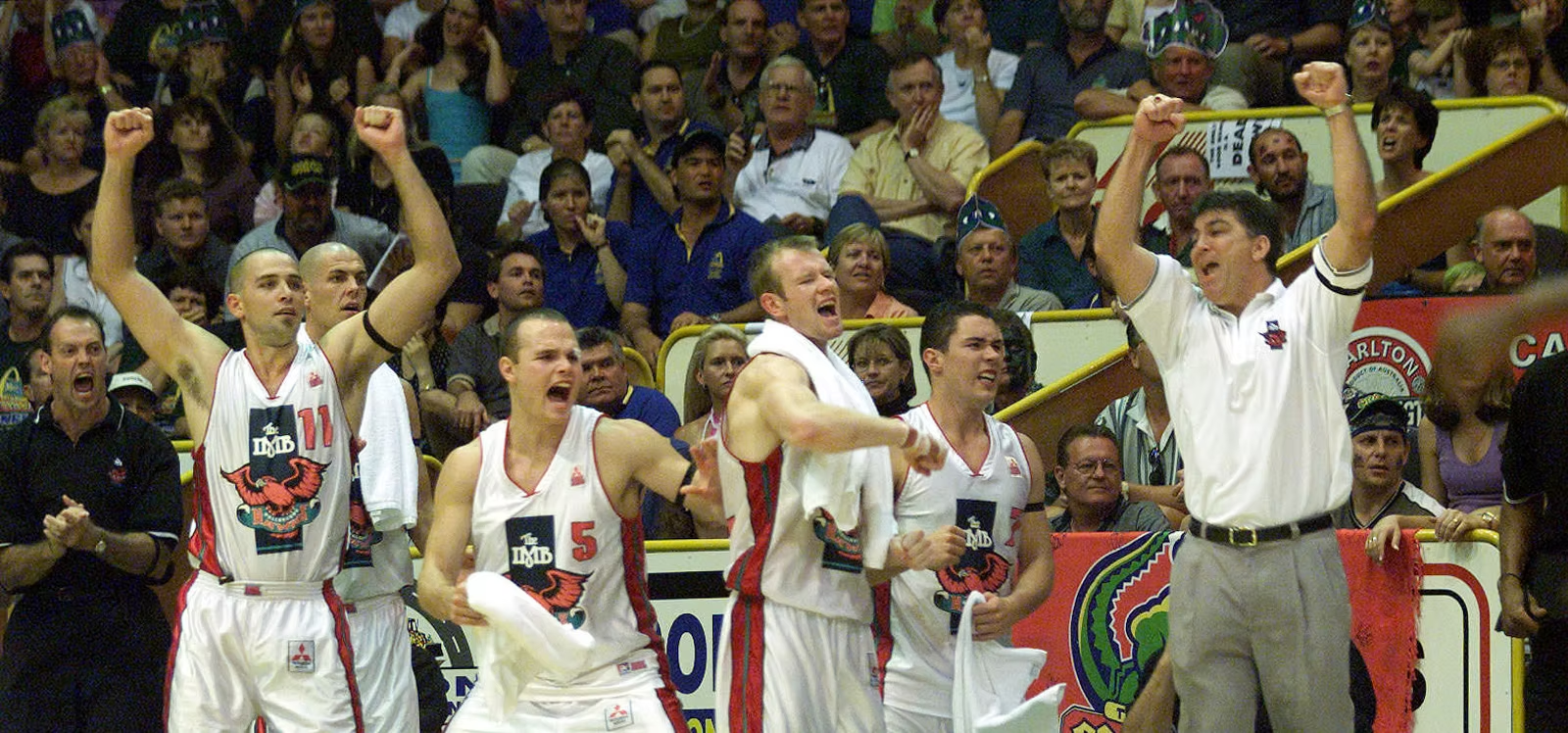
In the Grand Final against Townsville, Glen Saville was at his imperious best, earning the Grand Final MVP as the Hawks captured their first-ever NBL Championship. When the team returned to Wollongong, fans lined the streets from the Northern Illawarra suburbs all the way into the city. Over 3,000 people had watched Game 3 on the big screen at the WIN Entertainment Centre. The city had been waiting for this moment for twenty-two years.
It would be another twenty-four before they'd feel it again.
The Long Middle: Heartbreak and Survival
What followed the championship was a story not of decline so much as of stubborn persistence against difficult odds.
The Hawks made the Grand Final again in 2004/05, only to be swept by the Sydney Kings. Darnell Mee was brilliant that year, earning All-NBL First Team and the Best Defensive Player award. Cortez Groves led the league in scoring during 2005/06. Individual excellence was never the problem. Sustained team success was elusive.
And then, in 2007/08 and 2008/09, the darkness really set in. Back-to-back missed playoffs. Financial pressures spiralling out of control. By the end of 2008/09, the Hawks publicly announced they could not meet the financial requirements to compete in the restructured NBL. The possibility of the club folding, after thirty years, became very real.
An emotional farewell game at the WIN on 13 February 2009 drew more than 5,700 people. Many believed it was the end.
It wasn't. Captain Mat Campbell refused to accept that. He launched the "Save the Hawks" campaign. The community rallied. Local businesses stepped up. Nearly 100 fans each pledged $5,000. Indian mining magnate Arun Jagatramka provided a $1 million bank guarantee. Naming rights sponsor ahm returned. The club was saved.
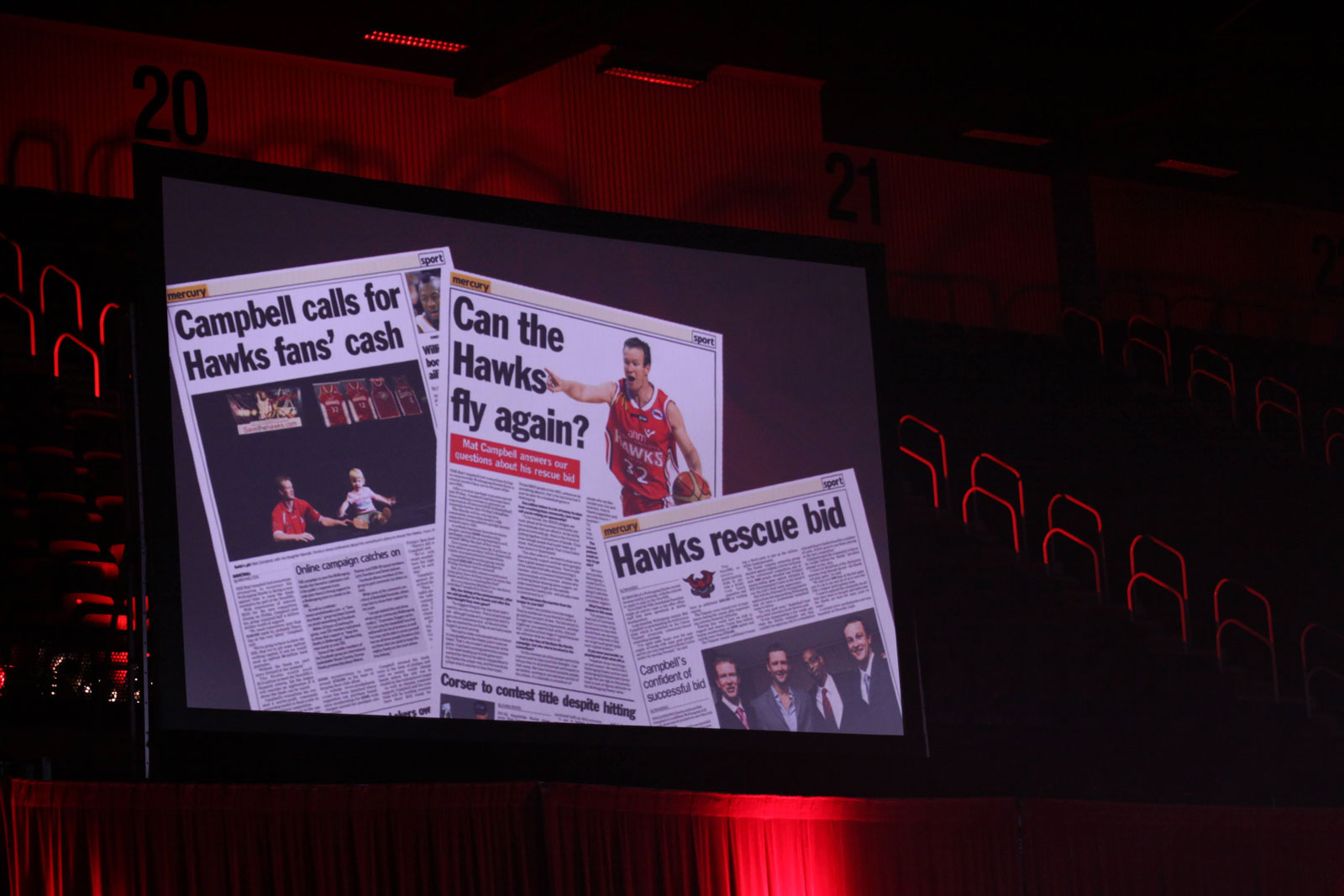
What happened next is one of the most remarkable stories in Australian sport. The newly reconstituted, community-owned Illawarra Hawks, written off by every expert, went and won the pre-season tournament in Darwin, made the Grand Final against Perth, and pushed the Wildcats to a Game 3. They lost, ultimately, but the run itself was breathtaking. Their returning coach? Gordie McLeod, former captain and club legend, who was named NBL Coach of the Year for his efforts.
The MVPs, the Stars, and the Lean Years
The decade that followed was marked by flashes of genuine brilliance against a backdrop of financial fragility.
Gary Ervin won the NBL MVP in 2010/11, the first Hawk to claim the award since Mike Jones, thirty years prior. Rotnei Clarke claimed the MVP in 2013/14. Kevin Lisch delivered a remarkable 2015/16 double, taking home both the MVP and Best Defensive Player award. AJ Ogilvy was named to the All-NBL First Team in consecutive seasons. Rob Beveridge's fast-paced, run-and-gun system made the Hawks genuinely entertaining and got them to the 2016/17 Grand Final, where Perth proved too strong.
But there were also wooden spoons. Voluntary administrations, more than once. Ownership changes. Coaching changes.
The season LaMelo Ball arrived, in 2019/20, brought global attention and a Rookie of the Year award, and also a 5-23 record and another spell in administration.
Ball went third overall to the Charlotte Hornets in the 2020 NBA Draft, and in doing so he turned a small Illawarra club into a genuine NBA pathway. He wasn't the last. NBL Next Star AJ Johnson came through in 2023/24, and Lachlan Olbrich followed the same road from Wollongong toward the world's biggest league. A club this size, feeding the NBA.
Brian Goorjian's two-year tenure from 2020/21 brought stability, back-to-back finals appearances, and a culture rebuild. When he left, Jacob Jackomas took over. The Hawks struggled. Then, mid-season in 2023/24, with the team sitting at 2-7, they turned to assistant coach Justin Tatum who helped orchestrate a surge, all the way to a deciding Game 3 of the Semi Final series against Melbourne United.
The rest, you know.

What It All Means
There's a reason the 2024/25 championship felt the way it did for Illawarra people. It wasn't just the basketball, though the basketball was extraordinary, from Trey Kell's MVP-calibre regular season to Harvey's dagger in Game 2 of the Grand Final to Will Hickey blocking everything out at the free-throw line in Melbourne and seeing only the rim.
It was everything before it. Every save-the-club campaign. Every near-miss. Every Mike Jones jumper in the Snakepit. Every Glen Saville soaring block. Every time volunteers, fans, sponsors and then Mat Campbell refused to let this club die.
The Illawarra Hawks have been playing NBL basketball since 1979. Through every season, every financial crisis, every ownership change, we've kept turning up. That's not accidental. That's who we are.
The second banner didn't come out of nowhere. It came from all of that.
Legends in the Rafters
History is remembered by the names that hang above the court. To date, five legends have had their numbers retired, their legacies woven permanently into the fabric of the club:
- #4 Chuck Harmison: The relentless import turned local icon, including a stint as General Manager for the 2001 Championship.
- #5 Gordie McLeod: The maestro of Illawarra basketball. The point guard in the 80s, the coach 30 years later.
- #12 Glen Saville: The championship winner, do-it-all forward and all time leader in Hawks games played and many other categories.
- #32 Mat Campbell: The heart, soul, and saviour of the club. The GM for the NBL25 Championship.
- #33 Melvin Thomas: The explosive versatile scorer and rebounding American import in his first stint, to a veteran leader "Australian" in his championship winning second stint in the early 2000s.
Two titles. Five decades. One community. The Hawks fly on.
General Enquiries
Have a question, comment, or just want to say hi? Fill out the form and we’ll get back to you as soon as we can.
Support your team with the latest gear
Grab your latest team releases before they're gone.
Follow for behind the scenes content


Get the latest Team Updates
Breaking news & special offers. Direct to your inbox.
NBL27 Memberships Hawkheads don't watch from home
NBL Properties



Subscribe to our Newsletter
The National Basketball League acknowledges the Traditional Custodians of the lands on which we work, live & play. We pay our respects to their Elders past, present & emerging as well as all Aboriginal and Torres Strait Island Community. © year National Basketball League |Terms & Conditions | Privacy Policy